
Building Before Winning
What the right gets wrong about how power actually works

In my last essay, I argued that Restore Britain will fail — not because their instincts are wrong, but because the timing is. Breakaway parties succeed when the parent movement has already established a new political order. They fail when they split before that order is in place.
But that raises a harder question. If the answer isn’t launching a purer party, what is it? What should people who understand what’s at stake actually be doing?
I recently talked through this question, with someone who has spent the better part of two decades trying to answer it, and failing at it in instructive ways.
The Wreckage of Good Intentions
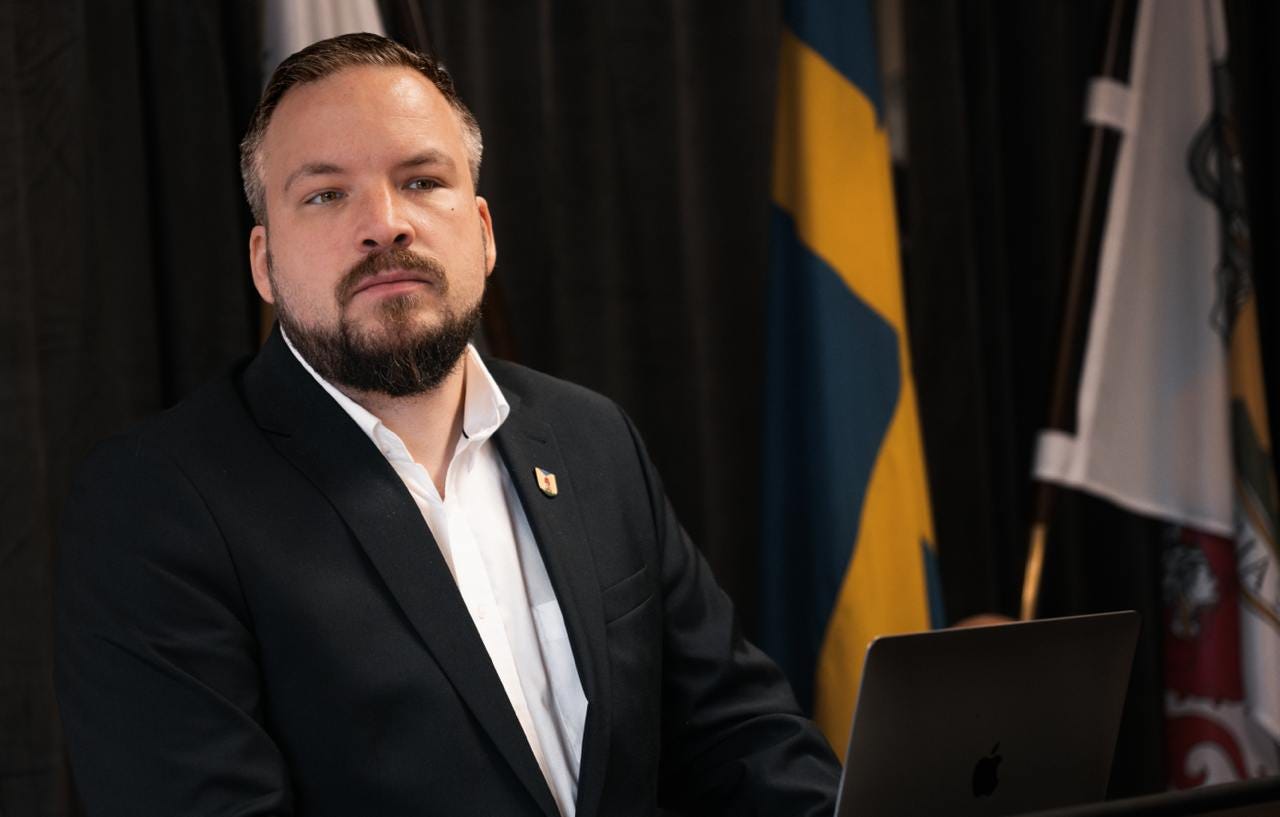
Dan Eriksson has been involved in Swedish nationalist circles since the early 2000s. He co-founded Det fria Sverige, Free Sweden, in 2017 with an ambitious mandate: build physical meeting places, own the infrastructure, create something that couldn’t be deplatformed or defunded. The launch was striking. Over 500 members signed up in the first 24 hours. Within the first month, they'd raised enough to start looking seriously at property.
Then, in the summer of 2024, a bank closed their account. And when they tried to open a new one, every other bank refused. No account could be opened, and the association, legally, ceased to exist. It’s one of the reasons they now accept and promote Bitcoin — one of the few organizations in Sweden that does.

What strikes me about how Dan talks about this period is the absence of self-pity. He doesn’t frame it as persecution, though it clearly was. He frames it as information.
Think about it the same way I described political order in my essay on Restore Britain — what it actually means for a movement to have truly won. Imagine a Social Democratic association in Sweden in the 1980s, at the height of that movement’s cultural dominance, being denied a bank account. It’s not just that it wouldn’t happen. It’s that the idea of it happening is incomprehensible. That incomprehensibility is what actual power looks like.
The Five Layers
What Dan and his collaborators have developed out of this wreckage is something more interesting than a rebuilt organization. It’s a model, a way of understanding how political change actually happens.
He calls it the layer model: five concentric rings, from the outside in.
The outermost layer is mass politics. Parties, elections, campaigns, parliament. This is what most people mean when they say “politics.” It’s where the loudest arguments happen and where the least fundamental change occurs.
Inside that is the strategic public sphere — opinion writers, podcasters, alternative media, commentators. This layer translates deeper ideas into what can be said publicly. It operates at the edge of what mass politics can absorb, and it pulls the Overton window by standing just outside it.
Deeper still is cultural infrastructure. Stories, symbols, aesthetic ideals, shared memory. This is where human intuition gets formed — what feels right, what feels possible, what feels like “us.” It moves slowly, often across generations. But it is where political conditions are actually created.
Below that is the level of ideas — thinkers, historians, the coherent worldviews that give the layers above them their raw material. The audience here is tiny. The task isn’t to be popular; it’s to be consistent and durable over time.
And at the core: the existential questions. What are we? What is a people? What do we owe to those who come after us? This layer touches a fraction of a percent of the population. But nothing in the outer layers holds together without it.
Power tend to flow from the inside out. Mass politics can only do what the cultural layer has already made possible. Culture can only absorb what the idea layer has already worked through.
Dan points to the homosexual rights movement as a clear example of this in modern Western history. The full agenda, same-sex marriage and adoption, the whole arc, existed in embryonic form in activist circles as far back as the 1920s. But in 1950, you couldn’t run on it in mass politics. The cultural groundwork hadn’t been laid. So the movement worked the inner layers first: decriminalization, then destigmatization, then cultural normalization, then legal recognition, step by step. Each layer had to be prepared before the next one was ready. The person screaming the full program in 1950 didn’t advance the cause. They set it back by exposing it before the ground was ready.
The people who actually changed things were the ones who understood which layer they were working in, and didn’t confuse it with another.
The Bubble Problem
Dan describes the nationalist subculture of the 1990s and 2000s, in his words, “almost entirely disconnected from reality.”
Not in the sense that its diagnosis was wrong, he thinks much of it was right. But the movement existed inside a sealed world with its own internal logic, its own vocabulary, its own status hierarchies, its own idea of what “serious” looked like. “It was like a live-action roleplay,” he said. “There was almost no real analysis of how power is built, how change actually happens. People had read a book and felt something, and then they wanted to act that out.”
But the ideas haven’t hardened into culture. The culture hasn’t produced the kind and amount of people who can operate effectively in the strategic public sphere. So what you get instead is performance, directed inward, for an audience of the already convinced.
This is the bubble problem, you are preaching to the choir, and it’s not unique to the right. Every outsider movement falls into it when it stops asking “how do we actually change things” and starts asking “how do we express who we are.” The latter is a social function, and it has nothing to do with power.
What Building Actually Looks Like
What Dan’s organization is building now, under the name Vårdkasen, a beacon fire, the kind lit on hilltops to signal across distances, is concrete: physical meeting places in different parts of Sweden, a knowledge base, an academy with courses and full educational programs launching imminently, an internal job exchange so members can find work and hire within the community. And a membership structure with two tracks: a general membership open to anyone, and an organized membership that requires interviews, background checks, and a genuine commitment to contributing to the structure.
It is cultural infrastructure being built from the inside out, as Dan’s layer model describes.
The clearest parallel I know is Orania. I’ve written about the town at length and spent time there, it’s the subject of my book Orania: Building a Nation. What they’ve built in the Northern Cape is the most concrete example I’ve encountered of what a real foothold looks like. An actual functioning community with its own economy, its own institutions, its own future. Young couples in Orania talk about having ten or twelve children. In the rest of South Africa I’ve sat across from married couples, more than a few, who have decided not to have children at all. Because they genuinely cannot picture a future worth bringing children into.
Elections as Thermometers
Sweden has a parliamentary election coming. How does all of this fit with actually going to vote?
Dan will vote for the Sweden Democrats — for the first time. “An election is a thermometer in the sauna,” he said. “It tells you how hot you’ve managed to get the room. It doesn’t heat the room.”
The work that heats the room happens in all the other layers, on all the other days. He compared voting to a free punch you’re handed at the end of a boxing round — you take it, obviously. But the round itself, the three minutes of actual fighting before that bell, is what determines the outcome. Confusing the free punch with the match is how people end up thinking they’ve done something when they haven’t.
What he’s describing is the strategic clarity of someone who has finally understood which layer he’s working in, and stopped wasting energy pretending to work in another.
The Long Work
The movements that actually change things, on any side, don’t start by winning elections. They start by doing the work in the inner layers: clarifying ideas, building culture, creating institutions that can survive pressure.
We are somewhere in an early phase, but the zeitgeist is shifting. The outer conditions are more favorable than they’ve been in a generation. But favorable conditions aren’t the same as a prepared foundation. And a movement that tries to express at the mass politics level what hasn’t yet been worked through in the deeper layers will have a hard time without a proper foothold against the existing order.
The banking thing matters. When they can close your accounts without consequence, that’s information about where you actually stand in the layer structure. It means the cultural work hasn’t been done yet. It means you don’t yet have enough people who are willing to bear a social cost on your behalf, because the culture hasn’t made that cost feel worthwhile. This is also why parallel financial infrastructure isn’t just ideologically interesting — it’s structurally necessary. The communities I’ve spent time with in South Africa, from Orania to Bitcoin circular economies, understood this before most. That’s what my book Parallel Order is about.
When that changes, when denying a bank account to a national community organization would be genuinely unthinkable, you’ll know the work has been done.
There is nothing that can stop an idea whose time has come. But the time doesn’t come on its own. You have to build the conditions for it.
That’s the work.
Jonas Nilsson
If you want to follow this kind of analysis as it develops, consider subscribing. It’s how this work stays independent.