
Citizen Vigilante
The People Who Stayed

This is the first of two essays on Citizen Vigilante. Read part II here.
A low-budget European film premiered just a few days ago. It has already earned tens of millions of dollars, been banned in Germany, and become one of the most talked-about cultural events in Europe. But what interests me isn’t the controversy. It’s the man who made it.
They shot the film in Croatia, set in an anonymized European city that could be anywhere in Western Europe. That anonymity is deliberate and surprisingly effective. The problems the film depicts — immigrant violence, a justice system that protects perpetrators, institutions that prioritize the multicultural narrative over the safety of their own citizens — are not German problems or French problems or Swedish problems. They are European problems, and the film captures that shared condition without needing to locate itself in a single country.
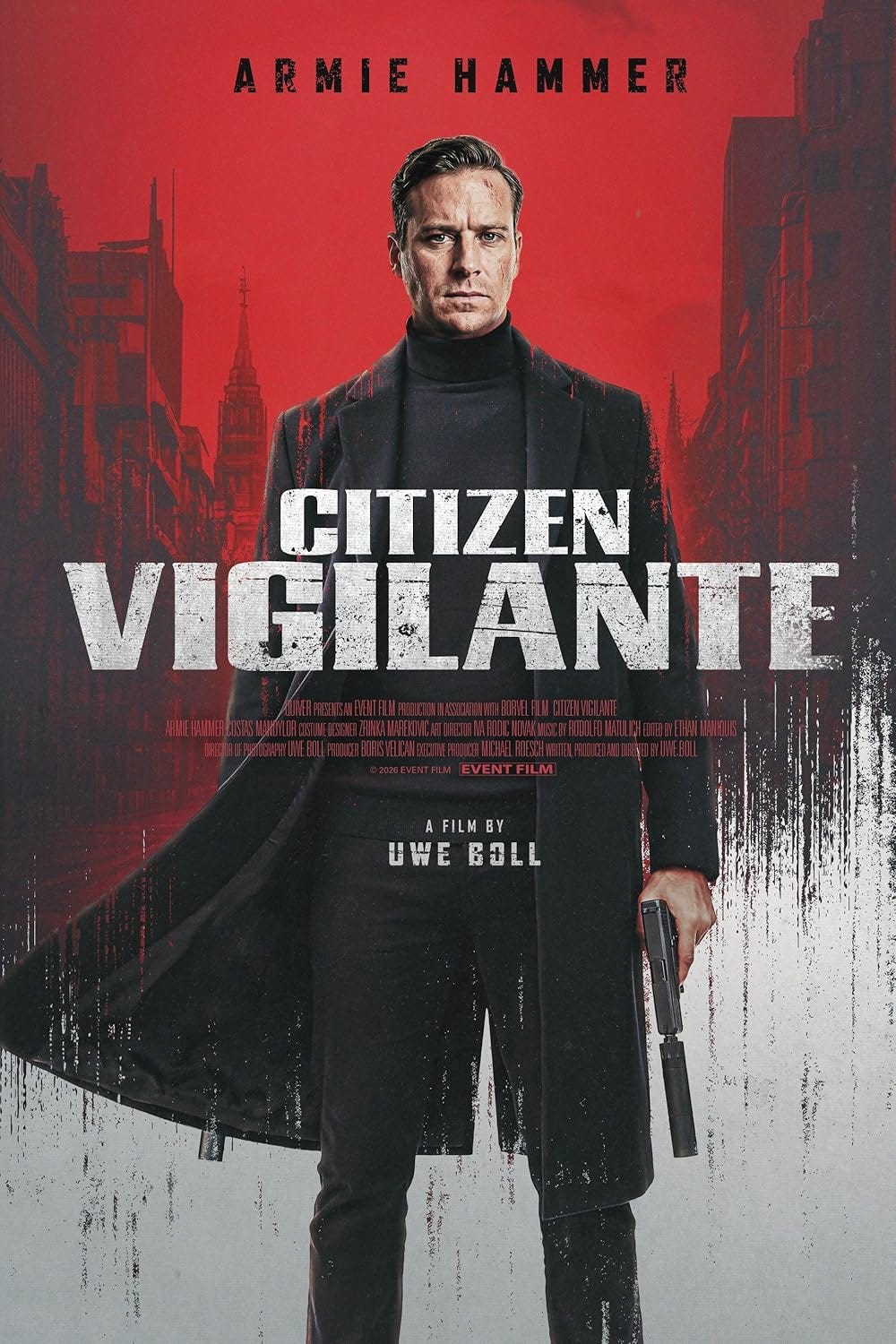
The plot is straightforward. A woman is murdered by an immigrant in front of her child. A young girl is gang-raped by immigrants, who are then released without prison sentences. The judge explains that we must understand what these men have been through, that they come from difficult circumstances, that we must be forgiving. An American ex-military officer named Sanders has come to Europe to take over his late father’s property business, and he goes to the victims and asks them a simple question: do you feel that justice has been served? They say no, and he takes matters into his own hands.
The film had its premiere days ago and has already earned 67 million dollars. It is the most culturally relevant film I have seen in a very long time, and it is relevant because it says what everyone already knows and nobody in the institutional culture industry is willing to put on screen.
Boll ends the film with Sanders, still uncaught, delivering a message directly to the audience: “I do this for you until you learn to do it for yourself.” And after that, a dedication from Boll himself: “This film is dedicated to the thousands of rape and murder victims in Europe who were betrayed by our legal system.”
In 2022, the German filmmaker Uwe Boll published a book. It was about the things you’re not supposed to say in Germany — immigration, Islamism, the justice system, the gap between what people experience and what the establishment insists is true. This is the kind of book that people write when they wake up. You see the problems, you feel compelled to speak, and you reach for the most available medium: write a book, start a podcast, inform people about the crazy stuff going on, to tell people to wake up because this is insane.
When I entered political activism as a teenager in the late 1990s, nobody supported the cause from within their profession. That was the spirit of the time. You got so heavily ostracized that it was considered impossible. Even professors, and I write “even” because it is one of few positions where it is extremely hard to get fired, quite a lot of them started talking openly as political commentators in Sweden in the mid 2010s, but the thing they all had in common was that they were retired.
They do excellent work, and their academic titles still carry weight. But the fact that they are retired means, logically, that there are many active professors who think the same way but are waiting. They sit within the most protected professional role in society, with tenure and academic freedom as explicit institutional guarantees, and yet they wait until they are no longer inside the institution before they speak. As Aristotle put it, the only one who can survive entirely alone is either a beast or a god. But I think we are entering a cycle where you no longer need to be either to act on what you see. There are enough of us now that the isolation is no longer total.
Looking back at this time the pattern was: you wake up, and you leave, or you wait to speak up until after you leave. You leave the thing you were good at to enter a space where you work with commentary, rather than creation within the craftsmanship that you had mastered. The journalist becomes an activist, and the celebrity starts a podcast. The entrepreneur donates to dissident causes.
I think a clear international example would be Russell Brand. He was known as an actor and comedian, and he is genuinely talented at both. When he woke up, he started a podcast and became an opinion maker. He has been enormously successful at it, I am not saying there is anything wrong with it. Brand has reached millions of people and shifted conversations. But he largely left his craft to do it. The acting and the comedy became secondary to the commentary.
This has been the dominant model since my awakening in the 1990s. Wake up, step out, and start talking, or handing out flyers back then. But I think we are entering a different cycle.
Uwe Boll woke up somewhere along the way, I don’t know when, but he released a book in 2022. If he had stayed with that, continued down that line, maybe done a lot of guest appearances on different podcasts, joined the AfD and run for parliament, he would have fitted within that pattern. But he did something else — he made Citizen Vigilante.
The book is not what is banned in Germany, and the book is not what has people across Europe talking.
The success of this film is because Boll took his awakening back into his actual craft. He did what he knows how to do, make films, and he poured his understanding of the world into that craft. The result is a piece of culture that smashes through the barrier to the broader societal discourse through entertainment.
Mel Gibson did something similar. When he fell out with Hollywood, he could have become a commentator. He could have started a podcast, written op-eds, joined the growing ecosystem of dissident media. Given his name recognition, he would have been enormous. Instead, he went independent and made the films he wanted to make without Hollywood’s ideological filter.
Elon Musk is the most visible example of the same principle. When Musk woke up to the problems of censorship and multiculturalism, he didn’t leave entrepreneurship to become a media commentator. He bought Twitter, and he took his competence, building and acquiring companies, and applied it to the problem he saw. The result is a platform that has fundamentally altered the information landscape in ways that no podcast or alternative media outlet could have achieved, and it is through that platform that Citizen Vigilante itself reached much of its audience.
What these people have in common is that they did not leave their domain. Their work became their politics.
And this applies far beyond celebrities and billionaires, you can think of it at every scale.
A business owner who wakes up doesn’t need to become a political commentator. He can ask himself where he places his production. Does he manufacture in his own country? Which suppliers does he use? Which subcontractors does he hire? What kind of product does he sell, and is it something he genuinely wants his customers to consume? A business run with awareness becomes a form of resistance in itself.
I think we are moving into a time where people can have impact from within their professional role, where the craft and the conviction stop being two separate compartments.
No more two silos. One where you do your job during the day, and another where you fight for what you believe in after hours, and the two never touch.
What Boll represents, and Gibson, and Musk, and increasingly others at every level, is the collapse of that separation. The work and the conviction flow into the same channel.
The most effective resistance may not come from people who left everything to fight, but from people who stayed where they were and brought the fight into what they do.
Boll said it through Sanders: “I do this for you until you learn to do it for yourself.”
I think what he means is simpler than it sounds. Take whatever it is you are good at, and stop pretending it has nothing to do with the world you live in.
The next essay will look at why the anti-hero has become our era’s defining cultural figure. Read part II here.
Further reading
Available on Amazon.
Thanks for the movie review. I hadn't heard of it in the US.
In the US younger people, especially ccllege-educated women, seem to be moving further anti-western. Do you have similar demographic trends in Sweden or the rest of Europe? I appears the UK is getting worse, other than a few riots.
In the high arts in general, there doesn't seem to be any movement at all. It's very anti-western. Although the new LA County Museum of Art (LACMA) is mixing traditional western art with Modern, African or Asian art unironically. Usually traditional western art is banned entirely, at institutions like the Whitney or MOMA, or else only shown in special museums like the National Gallery or the Metropolitan Museum in NY.