
Let Them Watch Odyssey

Christopher Nolan is one of the most respected directors in Hollywood today. He made the Batman trilogy, which I genuinely appreciated and still reference regularly. My favorite is the exchange between Bane and Daggett in The Dark Knight Rises. Daggett believes he is in control because he has financed Bane's operation. Bane places a hand on his shoulder and asks, "Do you feel in charge?" Daggett, beginning to understand the situation, replies: "I've paid you a small fortune." Bane: "And this gives you power over me?" They were operating from two entirely different value systems, which is what Nolan himself is now doing in relation to his own audience with his latest film.
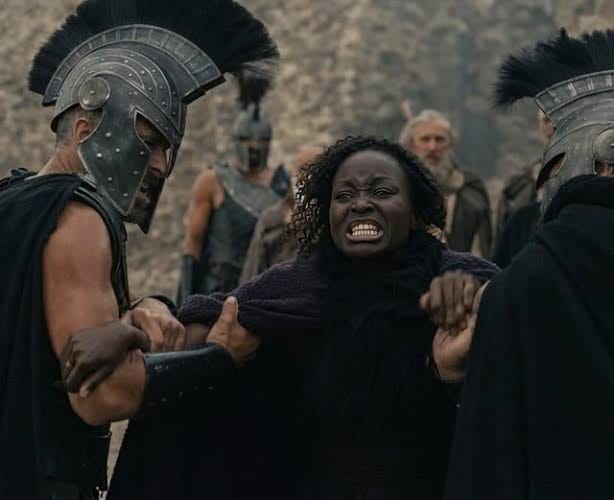
When the first images from his upcoming film The Odyssey appeared, much of the public wasn’t talking about Homer’s epic story. They were talking about the casting decisions. A young black girl from Africa cast as Helen of Troy, and Elliot Page, a biological female who has legally transitioned to male, confirmed as part of the cast. The specific role has not been publicly announced, but the rumor that spread was Achilles, and the rumor alone was enough to set the tone of the conversation.
The casting itself is not particularly interesting. We have seen this constantly the last decade. What is interesting is why a director who clearly does not need to prove himself to anyone makes these kinds of decisions.
Since 2024, the Academy Awards require films to meet specific representation criteria in casting and crew composition to qualify for Best Picture. These are checkboxes and a film that fails to meet them is ineligible regardless of its artistic merit. If you want the industry’s highest recognition, your film must conform to a set of ideological requirements that have nothing to do with storytelling.
Casting decisions are made with an eye to the people who will judge the film rather than the people who will watch it.
In academia, this happened decades ago. Papers are written for other academics, reviewed by other academics, published in journals read almost exclusively by other academics. The incentive structure rewards citation counts and peer approval. Whether the research means anything to the world outside the university is largely irrelevant to the career of the researcher.
Same goes for films that are increasingly produced for critics, festivals, juries, the Academy, and cultural journalists. The distance between critical acclaim and audience enthusiasm has become its own phenomenon.
This is what happens when a cultural elite begins producing for itself.
There is a phrase that captures this kind of disconnect, often attributed to Marie Antoinette. Let them eat cake. Whether she actually said it is beside the point. What the phrase captures is the moment when an elite has lost contact with the population it nominally serves and doesn’t realize it.
The Oscar ceremony’s television ratings have been declining for over a decade. The industry's explanations are almost everything except the possibility that the audience has concluded the product is no longer made for them.
Telos is the Greek word for direction, purpose, the end toward which something moves. A civilization’s stories are its telos. They carry the sense of who a people are and what is worth fighting for. The Iliad was a story about who the Greeks were and what was worth fighting for. It offered young men an ideal of courage and honor that shaped how generations understood duty.
Now imagine that story remade for the evaluators. A transgender Greek warrior, at fifty kilos. A Helen of Troy who bears no resemblance to the civilization that produced her. Who would dream of going into battle alongside that version of the myth? Instead of an epic that stirs something in the blood, you get a disillusioned freak show produced by people who feel no connection to the source material and no obligation to the audience that once drew meaning from it.
Civilizations rot from the head down. First the telos goes — the meaning, the self-respect, the identity, the spark. When that dies, everything else follows. The willingness to defend a country disappears, because who would risk their life for a nation that no longer feels like their own? Future visions evaporate. The population votes for whichever party promises the most in the moment. When that party fails to deliver, they vote for the opposition, which meets the same fate at the next election. And so it goes, round and round, a civilization running on inertia with no one at the wheel who dares to take out a real direction.
If cultural institutions stop serving their audience, the audience will eventually look elsewhere. That is exactly what happened with Citizen Vigilante.
Uwe Boll produced outside the legitimate sanctioned narrative and told a story that no one within the cultural elite are allowed to tell. And the film succeeded because it spoke directly to an audience that recognized their own reality on screen, an audience that the institutional culture industry has actively alienated.
This pattern is visible well beyond film. In journalism, the dynamic is particularly ironic. The profession whose stated purpose is to hold power accountable has become one where what matters most is how you are perceived within the profession itself. Journalists write for other journalists, get awarded by other journalists, and measure their careers by recognition from an establishment they were supposed to scrutinize. And the same profession that has abandoned its own mandate looks down on and smears the citizen journalists who actually do the work of holding power accountable. The grooming gang scandal was not broken by the institutional press. The Rotherham story was carried by independent reporters and bloggers for years before the mainstream media touched it, and when they finally did, they treated the people who had been covering it as the problem rather than as colleagues who had done their job for them.
The same tendency runs through publishing, television, music, and every other corner of the culture industry. What they produce is increasingly made to impress each other rather than to serve the people who were once the reason for their existence.
They may still possess the awards, the prestige, and the ceremony. But the distance between the institution and the audience has grown so wide, and the fatigue with race swapping, gender ideology, girl bosses, and the evil white man as the only acceptable villain has accumulated to such a degree, that people are simply fed up. And with that fatigue, the stories people actually consume will increasingly come from outside those institutions.
Nolan will probably make a beautiful film in a purely technical sense, and he will probably win his awards. It will be discussed mainly by the people who give those awards and the people who write about them. And they will dismiss all criticism as racism and sexism, the way they always do, because the possibility that the audience has legitimate reasons to reject what is being offered is laughable.
But somewhere outside that conversation, someone with a camera and no institutional backing will make something that millions of people actually want to watch. And everyone at the ceremony will be upset, the same way the institutional journalist gets upset at the citizen journalist doing the work they themselves should have done — how dare they, who do they think they are.
Further reading
Available on Amazon.
This film is an attempt to poison the well. It indicates mythic time to come. We will see more phoney epic in the coming years, from 'right wing' makers as well as the usual suspects. Lifeless forms. Bones by the roadside. Phoney epic provides a bigger stage upon which bad poets, and film makers, make themselves ridiculous.
Mythic time will not arrive for a while yet, but the appearance of a Helen of Troy you'd cross the road to avoid shows us what is coming. I write about the coming of mythic time in my essay, Poetry in a Time of Collapse.
Excellent article!